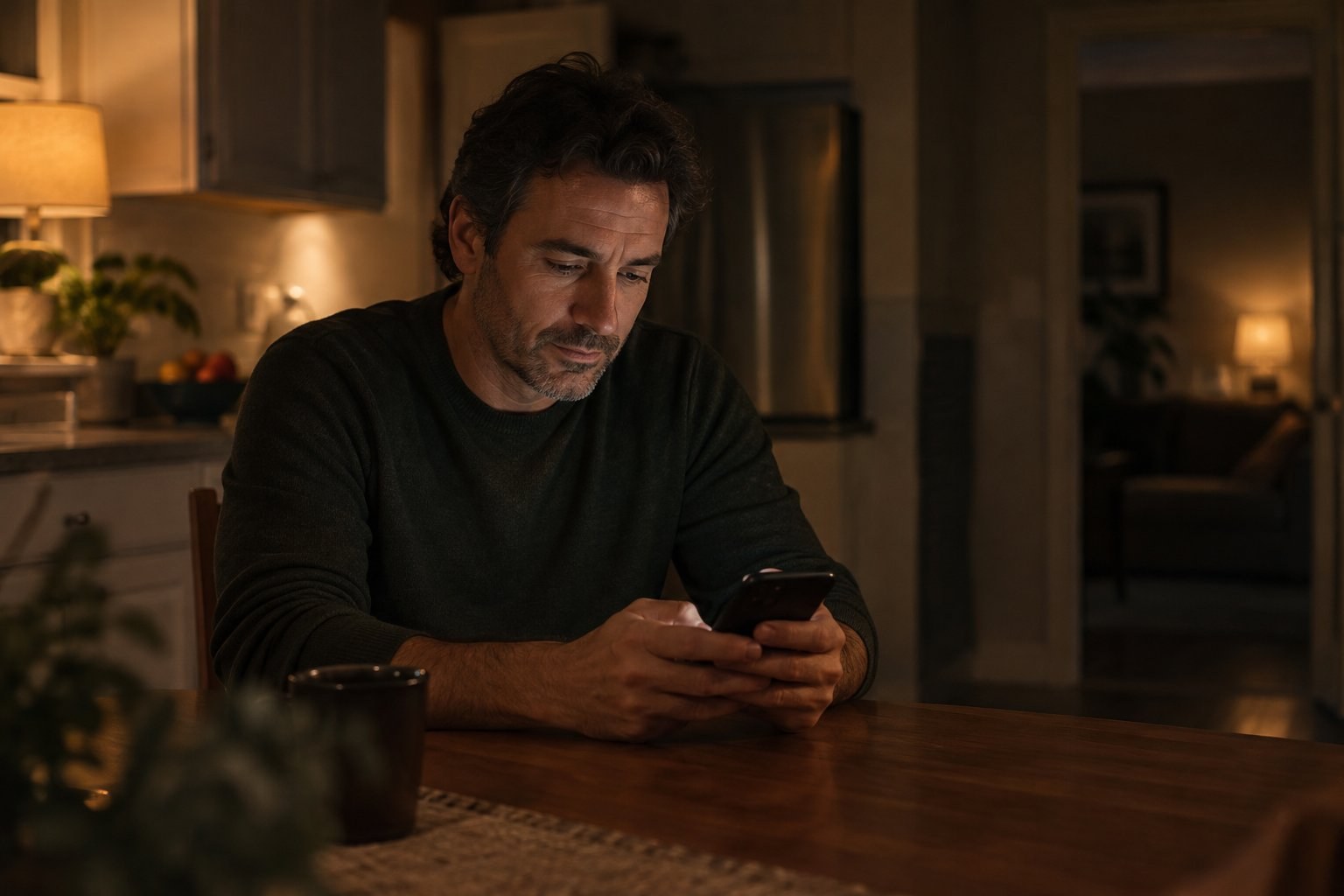
Your wife found out. Now you’re telling yourself the same thing you’ve told yourself for years: I’ll handle this. I just need to try harder this time.
I get why you’d think that. You handle everything else in your life. Your job, your finances, your family, the stuff that breaks around the house. Why would this be any different?
Here’s my honest answer, from years of doing this work and from living it myself: no, I don’t think you can recover from sex addiction on your own. That has nothing to do with being weak. It has to do with what addiction actually is.
A lot of people don’t like the word addiction, and even the mental health field doesn’t fully recognize sex addiction as its own diagnosis. The World Health Organization’s ICD-11 places compulsive sexual behavior disorder in the impulse-control category rather than with substance and gambling addictions, largely because there isn’t yet enough evidence that they work the same way (Kraus et al., “Compulsive sexual behaviour disorder in the ICD-11,” World Psychiatry, 2018). But when you look at what’s actually happening, it looks a lot like substance use or gambling.
Here’s the plain definition I use. Addiction is a behavior that keeps going even when you have a good reason to stop, and you find out you can’t. The National Institute on Alcohol Abuse and Alcoholism describes alcohol use disorder the same way: people want to cut down or stop, try, and can’t, even as it damages their lives (NIAAA, “Understanding Alcohol Use Disorder“).
That’s it. A behavior that keeps running after you’ve decided, for real, that you want it to stop. Calling it a bad habit or a character flaw misses that part.
Think about the guy who never even tries to quit. He might not want to, so it’s hard to call that addiction. But the guy who feels sick over what he’s doing, promises himself he’s done, and does it again anyway? That’s the pattern. That was me.
I felt bad. I kept doing it. I’d do it again and think, “What the hell is wrong with me?” That’s what addiction is.
Once that pattern set in, I couldn’t get honest about it, with myself or anyone else. Admitting it felt impossible.
So I told myself a story instead: I’m just going to do it today, and tomorrow I’ll get it together. Tomorrow, everything will be fine.
Tomorrow would come. And it was just another day to act out.
I lived that loop for years. I cared about my family, my career, and my life. That’s exactly why the gap between what I did and who I wanted to be was so hard to look at.
That gap is also where the lying comes from: the minimizing, the moments that look like gaslighting or narcissism. Calling it addiction doesn’t make any of that okay or excuse what it cost the people around you. Her pain is legitimate whether or not she stays, and this pattern is your work to do, not hers to manage. If you want the fuller picture, we’ve written about why cheaters lie.
If you’ve been doing this for years, you’ve already tested the solo approach. Repeatedly.
Willpower. Quiet promises. Maybe a filter you set up once and quietly disabled.
Trying harder is the same experiment, run again. And you already have the results: it didn’t hold. It’s part of why you’re reading this after a discovery instead of before one.
Here’s the part that’s hard to hear if you’re a capable, high-functioning guy. One of the main symptoms of this thing is lying to yourself. A 2009 review of brain research on drug addiction notes that more than 80% of addicted people don’t seek treatment, and suggests that what looks like “denial” may reflect problems in the brain networks behind insight and self-awareness, not just deliberate deception (Goldstein et al., “The Neurocircuitry of Impaired Insight in Drug Addiction,” Trends in Cognitive Sciences, 2009). That research is on drugs, but it matches what I see in men with this pattern. You need eyes that aren’t yours.
That’s the real reason this can’t be a solo project. Discipline aimed by a mind that’s already minimizing the problem doesn’t get you very far.
When men hear “you need help,” they picture something dramatic: standing up at a meeting, confessing to extended family, a public unraveling on top of the one at home.
At the start, it usually looks like a phone call.
One conversation with someone who has walked this road, who can ask the two or three questions you’ve been avoiding and help you see the pattern for what it is. That’s the whole first step.
From there, real recovery means structure you can’t fake your way around: daily honesty, accountability, and other men who know the whole story instead of the version you’ve edited. Our guide to porn addiction help walks through what that looks like, and a sex addiction assessment is a low-pressure way to see where you stand before you commit to anything.
None of this replaces facing what you did or what it cost your marriage. It gives you a shot at not repeating it, and at healing what’s underneath, which our piece on compulsive sexual behavior recovery covers. An accountability partner matters too, but a partner works alongside a real program, not instead of one.
You’ve already proven what happens when you try. The proof is why she found out in the first place.
In my experience, the men who stop for good are the ones who quit trying to win this by themselves. If you want to see what a structured sex addiction recovery program looks like, that’s a good place to start.
If you’re ready to stop running the same experiment, schedule a Confidential Recovery Session. It’s one honest conversation about where you are and what could help.


© 2026 Sex & Porn Addiction Recovery Program - wellnessseekersultd.com. All Rights Reserved.