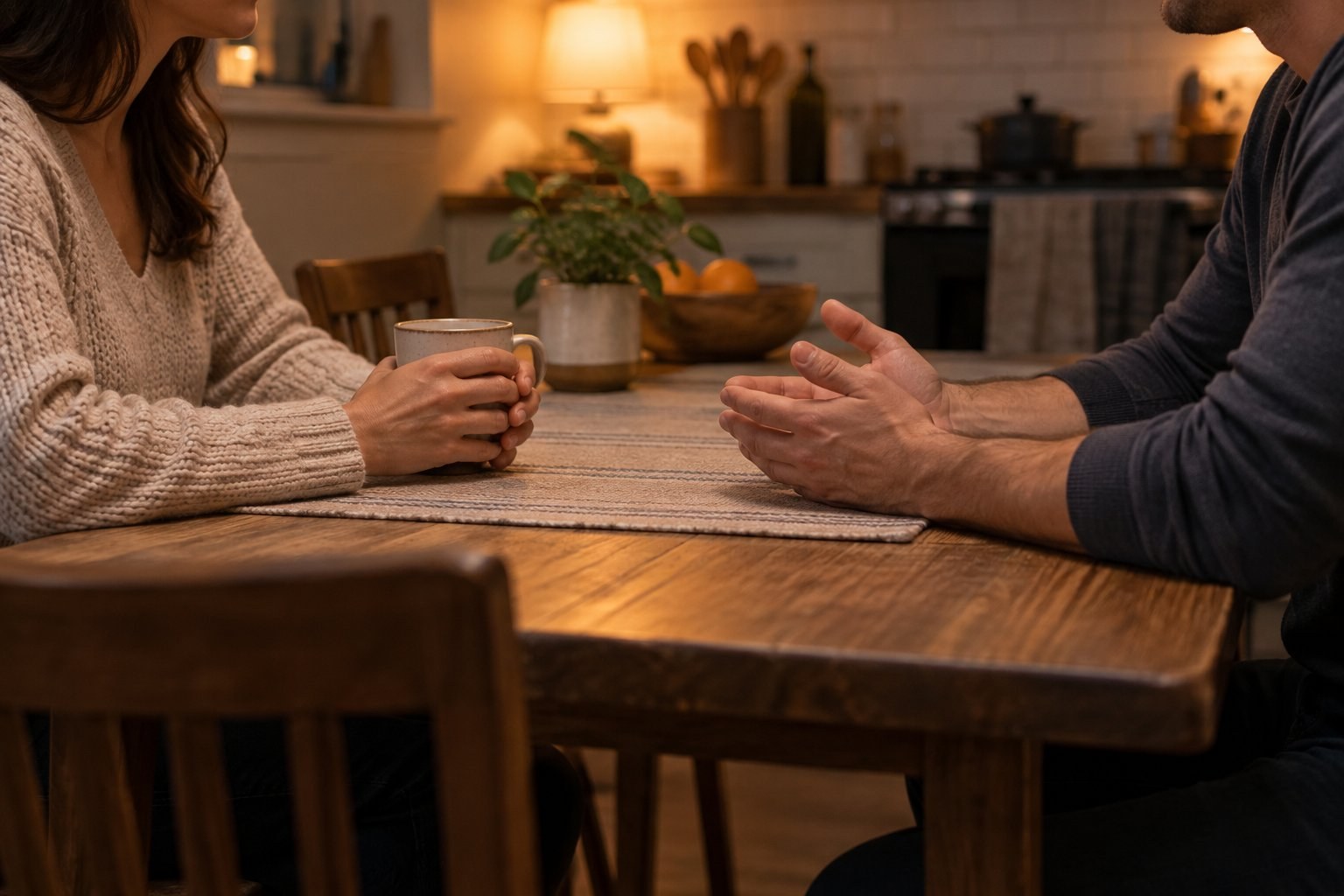
She asked you yesterday. She’s asking again tonight. And you can feel the irritation rising, because you already answered.
She keeps bringing it up because she’s still trying to make sense of what happened and check whether it’s safe now. Her questions test whether your story holds and whether you’ll stay steady. Each calm, honest answer gives her a little evidence. Each defensive one gives her a reason to keep asking.
Being betrayed by a partner can hit like a trauma. A qualitative study in Stress and Health cites research finding that 30% to 60% of betrayed partners have PTSD, depression, or anxiety symptoms at clinically meaningful levels. Not everyone reacts that way, but many replay what happened over and over.
A few things are often going on when the question returns:
If you want to understand what she may be carrying, read about betrayal trauma symptoms after infidelity. It’s written for her, and it will help you see the questions differently.
When a question comes back, the instinct is to protect yourself: “We’ve been over this.” “How many times do I have to say it?” “I’m doing everything you asked.”
The Gottman Institute describes defensiveness as a way of blaming your partner. Its antidote is taking responsibility. After an affair, your irritation tells her that her pain is an inconvenience to you, and that’s not far from how the secret felt.
You don’t need perfect words, just honest ones said calmly. Put these in your own language:
“You can ask me that as many times as you need. The answer is the same. Here it is again.”
“That makes sense. I made it hard to know what’s real. Here’s what I can tell you is true, and you can ask me about any of it.”
Tell the truth now. If you held something back, don’t wait to be caught again. Trickle truth turns every new detail into a new discovery. If you’re not sure why you kept lying, read why cheaters lie. If there’s a lot you haven’t said, get guidance from a licensed professional on disclosing it fully and carefully.
“You have every right to be angry. I’m not going anywhere. I’m listening.”
Then do the hardest part. Stop talking. Don’t add a defense to the end of a good answer.
“I’m so sorry. Do you think we’ll be okay?” That’s really a request for her to calm your fear. An apology owns the harm and asks for nothing back. If you’re waiting for her to say “it’s okay,” take that need to your own support. The shame spiral after cheating explains how this pulls her into caring for you.
“I’ve been to every meeting. I gave you my phone. What more do you want?” Keeping your commitments matters, but your checklist isn’t the same as her feeling safe. Trust returns through what she sees over time, not on your schedule.
If you agreed to transparency and now every question feels like an accusation, look at where your accountability lives. If she’s the only one checking on you, that’s too much weight for the person you hurt. Build accountability outside the marriage with a coach, group, or accountability partner, and answer her questions plainly anyway.
This is a common frustration in early recovery. You’ve changed a lot, and she still flinches when your phone buzzes.
Her fear doesn’t mean your work is fake. One good week can’t outweigh a long stretch of secrecy. Safety builds from repeated, boring consistency: the same honest answer, the same steady response, again and again. Nobody can tell you how long that takes.
Keep doing your recovery work whether or not she notices. Our guide to rebuilding trust was written about pornography, but the principle applies to any betrayal: consistent action slowly makes your words believable again.
Some nights you’ll be overwhelmed too. It’s okay to say, “I want to keep talking about this. I need twenty minutes to calm down so I can listen better. I’ll come back.” Then come back.
If the same conversation circles for weeks, a therapist experienced with infidelity can help you both, if you both choose that. Your own recovery support is still your job.
For many couples, the questions come less often as honesty becomes consistent and new discoveries stop. Some reminders may still sting years later, but you can face them together instead of fighting about them.
Answer what she’s asking honestly, and don’t add graphic details she didn’t ask for. If you’re unsure how much detail is helpful, ask a licensed professional to guide a structured disclosure rather than deciding alone.
Every time she asks and you stay steady, you’re showing her something a promise can’t. If you want recovery that doesn’t depend on her managing you, schedule a confidential recovery session. We’ll help you build the outside support and daily structure that make honesty easier to keep. Coaching isn’t therapy, and it doesn’t come with a guarantee about your marriage. It does mean you don’t have to figure this out alone.


© 2026 Sex & Porn Addiction Recovery Program - wellnessseekersultd.com. All Rights Reserved.