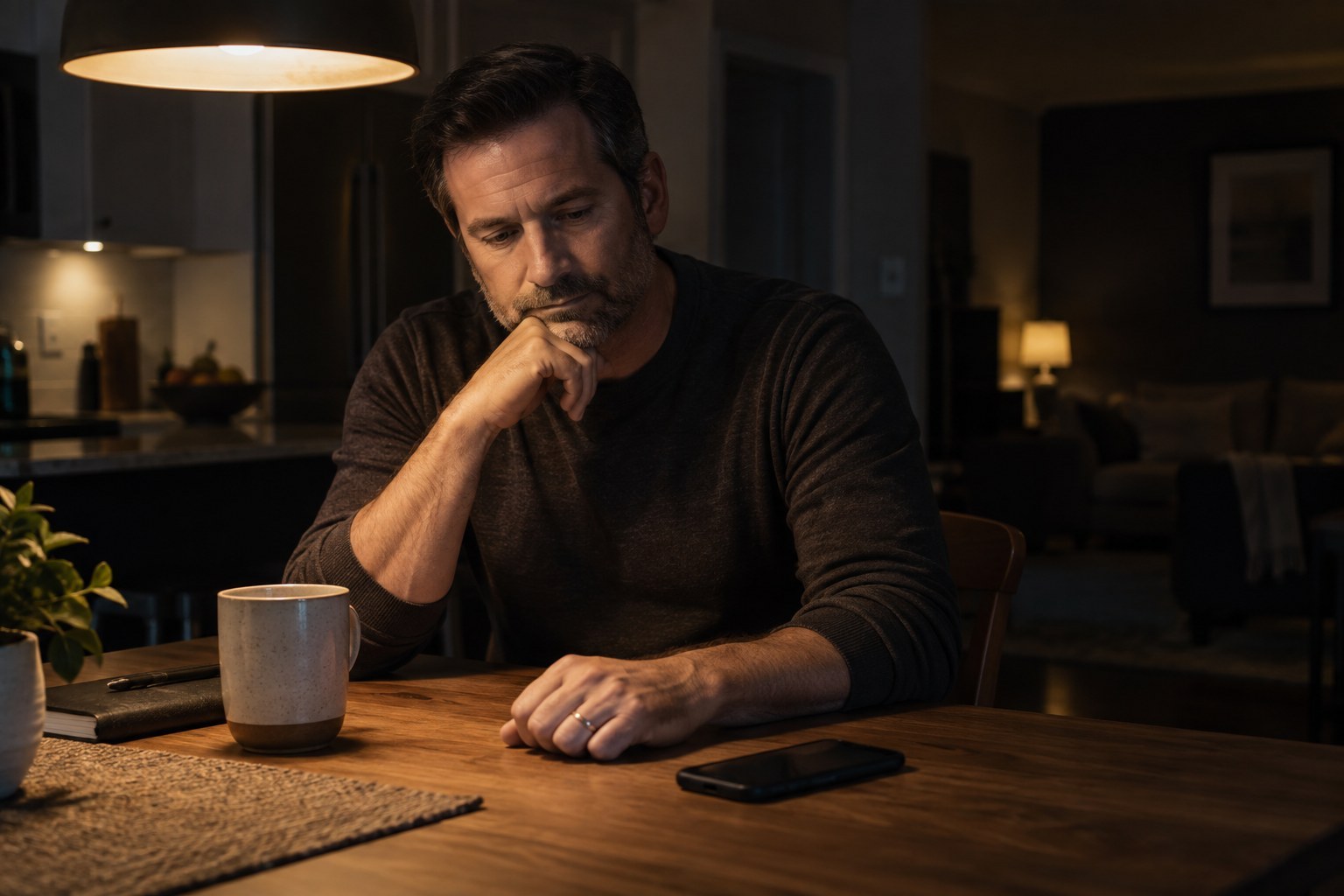
You got caught. Now you’re lying awake asking yourself the question underneath every other question: what kind of man does this?
I think about this all the time, because almost every client who comes to me starts the same way. There was a discovery. His wife found something, and now he’s sitting there trying to figure out what he actually is.
Here’s the honest answer. For a lot of men, it isn’t only a character problem. It’s a progression problem, and it still asks something of your character.
You don’t need a diagnosis to start answering this. You need to be honest about two things.
If you answered yes to both, that points toward more than a character problem. A man who simply doesn’t care usually doesn’t lose sleep over it. He does it, he lies when he’s caught, and he never really wants to change. If you’ve been sick over this for years, that’s a different picture.
A bad habit doesn’t hold up under real pressure either. Habits stop when the stakes get high enough. If your wife has already said something like “the next time it’s over” and you still couldn’t stop yourself, that’s not a habit anymore. That’s the inability to stop despite wanting to.
That’s one of the clinical markers of what’s now called compulsive sexual behavior disorder: continuing the pattern despite real, repeated consequences, even after repeated attempts to stop (World Health Organization’s ICD-11 diagnostic description, published in World Psychiatry). That’s not a diagnosis of you specifically, but it’s the same line I’m drawing above.
Here’s something I’ve seen over and over in my coaching. When it’s mostly a matter of bad choices, the pattern tends to stay about the same.
An addiction doesn’t work that way. It progresses.
Sometimes it looks like twenty years of porn use that leads from one thing to the next. You start looking at escort sites. Then you call one. Then you actually meet with one. And all of a sudden the thing has gone much further than you ever wanted it to go.
That pattern of needing more to get the same effect shows up in the research too. A 2024 study of more than 2,000 men in the journal Addictive Behaviors found that “quantitative tolerance,” needing more volume to get the same response, sat at the center of the link between other escalating patterns and difficulty controlling porn use (Ince et al., 2024). It’s a snapshot study, so it shows a connection, not a cause. That doesn’t mean everyone who watches porn ends up somewhere else. For men whose use is already compulsive, staying in the same place often isn’t how the pattern behaves.
This was true for me. I would tell myself, “I’m not going to do it again.” I promised myself and other people I wouldn’t do it again. And then I would do it again. It didn’t feel like a decision I kept making on purpose. It was the progression of an addiction. If you want to see how that usually unfolds, sex addiction progression walks through it.
Somewhere in there is a guy who genuinely believes tomorrow will be different. Tomorrow he’ll get it together. Tomorrow he’ll stop, and he won’t have to tell anybody. Then tomorrow comes, and tomorrow is just another day to act out, even when he doesn’t want to. That belief, that tomorrow will fix it, is the exact thing that kept the behavior running for years.
I want to be clear about something, because this is where men get it wrong in both directions.
Calling this an addiction doesn’t make it okay. It doesn’t erase what you did. You still have to face the consequences, and your wife’s pain is real whether the cause was a character flaw or a compulsion she never signed up to live with.
What naming it correctly does is tell you what actually needs to happen next. The two call for different work. If it’s only a matter of choices, the answer is to start choosing differently. A progression problem needs more than willpower, because something underneath is driving it. Either way, what you do next is still on you. If you’re the guy who feels sick over this and keeps doing it anyway, you’re not stuck being that guy forever. You can recover, but not by trying harder at the same thing that’s already failed for years. If you want to see how sex addiction and simple cheating actually differ, sex addiction vs cheating walks through that distinction in more detail.
Right now, in the days or weeks right after discovery, two things are true at once and neither one is waiting for you.
Your wife’s patience isn’t going to reset on its own. If this is a second or third chance, she’s watching what you do this week, not what you say about next month.
And the addiction isn’t pausing either. If you’re like most men I work with, lines you swore you’d never cross have already been crossed. Without something changing, the pattern doesn’t stay where it is. It keeps going.
You might feel more in control right now than you have in a long time. That’s fear talking, and fear is real, but it doesn’t last on its own. It’s held plenty of men steady for a week or a month before the same cycle started again. The window where you and your wife are both this motivated, both paying this much attention, doesn’t stay open forever. This is the moment to start doing something about the addiction itself, not just the moment to survive the conversation.
This isn’t unique to your situation. In substance use treatment guidance, outside pressure, like a confrontation with a spouse, is often what moves someone from not considering change to actually starting (SAMHSA’s Enhancing Motivation for Change treatment improvement protocol). That guidance is about substance use, not sex addiction specifically, but the same pattern, a crisis opening a door that wasn’t open before, is one I see constantly in my own coaching.
If you’re further along and the shame from all of this is what’s got you stuck, shame spiral after cheating is worth reading next. And if you’re ready to understand what recovering from this actually looks like day to day, compulsive sexual behavior recovery and sex addiction recovery program both lay that out.
It takes a man who feels bad about what he’s done. Who is genuinely sorry. Who is willing to get honest with himself first, and then honest with his wife. Who follows that up by actually doing the work recovery requires instead of white-knuckling it alone.
That man can recover from this. He can stop, and he can become the kind of husband and father he actually wants to be. What happens to the marriage isn’t something either of you can guarantee right now, and recovery is worth doing either way. It’s not quick, but it’s possible, and it starts with getting honest about which problem you’re actually facing.
If you’re ready to talk through what recovering from this looks like for you specifically, Schedule a Confidential Recovery Session with our team and we’ll help you figure out the next step.


© 2026 Sex & Porn Addiction Recovery Program - wellnessseekersultd.com. All Rights Reserved.