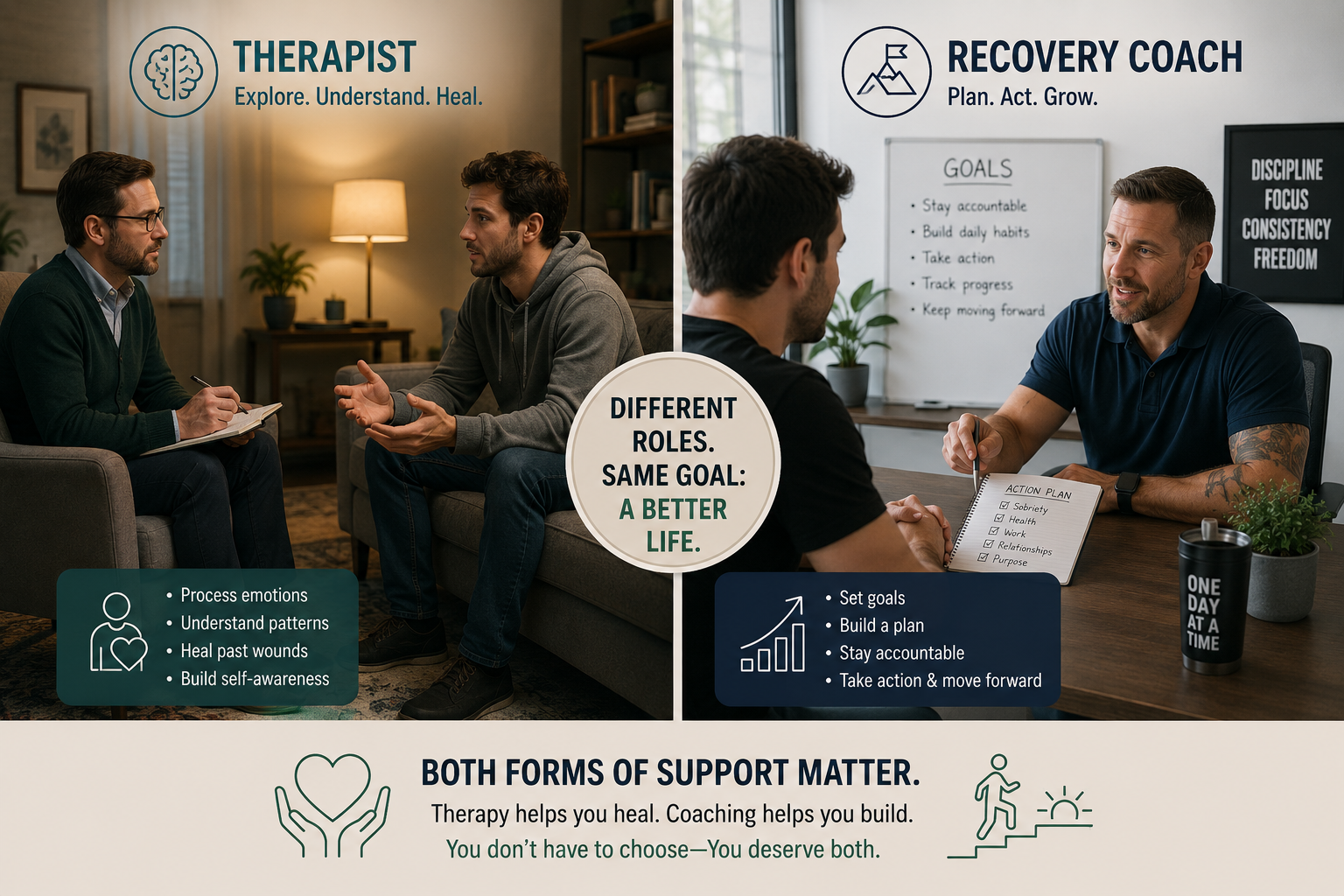
If you’re looking for help with pornography addiction or compulsive sexual behavior, you’ve probably come across both addiction coaches and therapists.
At first glance, they can seem like they do the same thing.
They don’t.
Both can play an important role in recovery, but they serve different purposes. Understanding the difference can help you choose the kind of support that’s right for your situation.
An addiction coach helps you make meaningful progress toward recovery by focusing on where you are today and where you want to go next.
Rather than diagnosing or treating mental health conditions, a coach helps you build the habits, accountability, and structure needed for long-term change.
An addiction coach may help you:
Coaching is action-oriented.
The focus is less on analyzing the past and more on helping you consistently move forward.
A licensed therapist is trained to assess, diagnose, and treat mental health conditions.
Depending on their training, a therapist may help with:
Therapy often explores how past experiences, emotional patterns, or mental health challenges influence current behavior.
For many people, that work is incredibly valuable.
A simple way to think about it is this:
A therapist helps treat mental health conditions.
A coach helps you implement lasting behavioral change.
Neither approach is “better.”
They’re simply designed for different purposes.
Absolutely.
In fact, many people benefit from having both.
For example:
The two approaches often complement one another rather than compete.
Coaching may be a good option if you:
Many men know exactly what they should do.
Their challenge isn’t knowledge.
It’s consistently following through.
That’s where coaching often provides tremendous value.
Therapy is often the better choice if you’re experiencing:
These situations deserve evaluation by a licensed mental health professional.
A coach should never attempt to replace appropriate clinical care.
One misconception is that quitting pornography is simply a matter of trying harder.
For many men, pornography became a way to cope with stress, loneliness, rejection, shame, or difficult emotions.
Recovery involves learning healthier ways to respond to those challenges.
Whether you work with a therapist, a coach, or both, the goal isn’t simply to stop a behavior.
It’s to build a healthier life that no longer depends on that behavior.
At Wellness Seekers Unlimited, we provide recovery coaching, not therapy.
That distinction is important.
Our coaches don’t diagnose mental health conditions or provide clinical treatment.
Instead, we help men:
When someone needs therapy or another level of clinical care, we encourage them to work with qualified licensed professionals while continuing coaching if appropriate.
Our goal is to help each person receive the type of support that best serves their recovery.
No. Therapists provide licensed mental health treatment, while addiction coaches focus on accountability, behavior change, and practical recovery strategies.
Yes. Many people benefit from combining therapy with coaching because each addresses different aspects of recovery.
If you’re looking for practical guidance, accountability, and a structured coaching program designed specifically for compulsive sexual behavior, Wellness Seekers Unlimited is here to help. Schedule a Confidential Recovery Session today.


© 2026 Sex & Porn Addiction Recovery Program - wellnessseekersultd.com. All Rights Reserved.