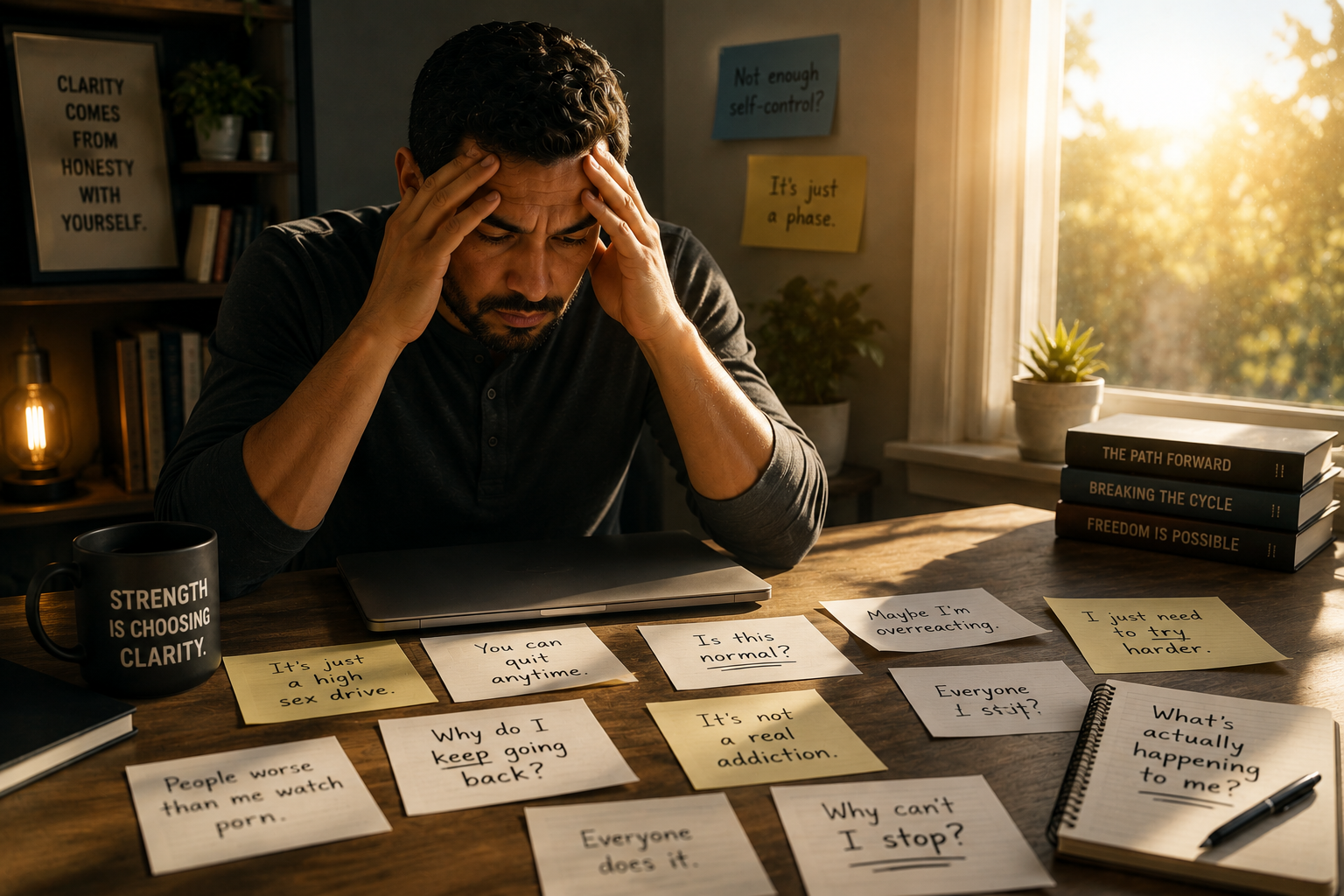
If you’ve ever wondered, “Is porn addiction real, or am I just making excuses?” you’re not alone.
Some people insist porn addiction doesn’t exist. Others feel trapped by pornography and know something isn’t right, even if they don’t have the words to explain it.
The debate can be confusing, especially when you’re looking for help instead of opinions.
Here’s what you need to know.
One reason this topic is so controversial is because experts don’t all use the same language.
The American Psychiatric Association does not recognize “porn addiction” as a distinct diagnosis in the Diagnostic and Statistical Manual of Mental Disorders, Fifth Edition, Text Revision (DSM-5-TR).
At the same time, the World Health Organization recognizes Compulsive Sexual Behaviour Disorder (CSBD) in the International Classification of Diseases (ICD-11). CSBD is classified as an impulse-control disorder and may include compulsive pornography use, but it is not synonymous with “porn addiction.”
Many professionals avoid the word addiction and instead describe the problem as compulsive behavior. Others believe pornography affects the brain and behavior in ways that closely resemble addictions to gambling or substances.
While the terminology differs, there’s broad agreement on one point:
People can develop a pattern of pornography use that feels increasingly difficult to control and causes real consequences.
For the person living it, the label often matters far less than the impact.
Watching pornography occasionally doesn’t automatically mean someone has an addiction.
The concern begins when pornography starts taking control instead of remaining a choice.
Some common signs include:
Many men describe the experience by saying, “I promised myself I wouldn’t do it again.”
Then they find themselves back in the same cycle days, hours, or even minutes later.
That loss of control is what deserves attention.
This is where the conversation becomes more helpful.
At Wellness Seekers Unlimited, we don’t spend much time arguing over labels.
Whether someone meets a clinical definition of addiction, compulsive behavior, or problematic pornography use, the question we care about is simple:
Is pornography controlling your life more than you are?
If the answer is yes, it’s worth addressing.
We’ve worked with countless men who weren’t just chasing pornography. They were trying to escape something underneath it.
For many, pornography became a way to cope with:
That’s why recovery isn’t just about removing pornography.
It’s about understanding what pornography has been doing for you and building healthier ways to meet those same needs.
Research continues to grow in this area.
Brain imaging studies have found similarities between compulsive pornography use and other compulsive behaviors, particularly in areas related to reward, motivation, and cravings.
At the same time, researchers continue to debate whether pornography should be classified as a traditional addiction.
That’s why you’ll see different terminology depending on the study you’re reading.
Even with that ongoing discussion, researchers generally agree that some individuals experience:
Those experiences are real, regardless of what they’re called.
Yes, but probably not for the reason you think.
Getting caught up in the debate can become another way to avoid taking action.
Imagine someone whose drinking has cost them their marriage and career.
Whether we call it alcohol addiction, alcohol dependence, or problematic alcohol use doesn’t change what needs to happen next.
The same principle applies here.
If pornography is damaging your relationships, affecting your confidence, interfering with intimacy, or leaving you feeling powerless, that’s the issue worth focusing on.
Many people believe recovery means using enough willpower to stop watching pornography.
That approach rarely lasts.
Real recovery usually involves:
Sobriety is an important milestone.
It just isn’t the finish line.
Lasting freedom comes from becoming healthier, not simply becoming better at resisting urges.
So, is porn addiction real?
The exact terminology is still debated among researchers and clinicians.
What isn’t debated is that many people struggle with compulsive pornography use that creates real pain, real consequences, and a genuine sense of losing control.
If that’s your experience, you don’t have to wait for experts to settle every definition before getting help.
You deserve support that focuses on understanding the whole picture, not just stopping a behavior.
Healing is possible, and it starts by taking your struggle seriously.
If pornography feels like it’s controlling more of your life than you want it to, you don’t have to figure it out alone.
Wellness Seekers Unlimited helps men move beyond simply quitting pornography by addressing the underlying patterns that keep them stuck and building a recovery that lasts. Schedule a Confidential Recovery Session today.
Porn addiction is not a standalone diagnosis in the DSM-5. However, the World Health Organization recognizes Compulsive Sexual Behavior Disorder (CSBD), which includes persistent patterns of uncontrolled sexual behaviors.
Yes. Many people achieve lasting recovery by combining accountability, healthier coping skills, and work on the underlying emotional issues that drive the behavior.
No. Occasional pornography use does not automatically indicate addiction or compulsive behavior. The concern is whether pornography has become difficult to control and continues despite harmful consequences.


© 2026 Sex & Porn Addiction Recovery Program - wellnessseekersultd.com. All Rights Reserved.