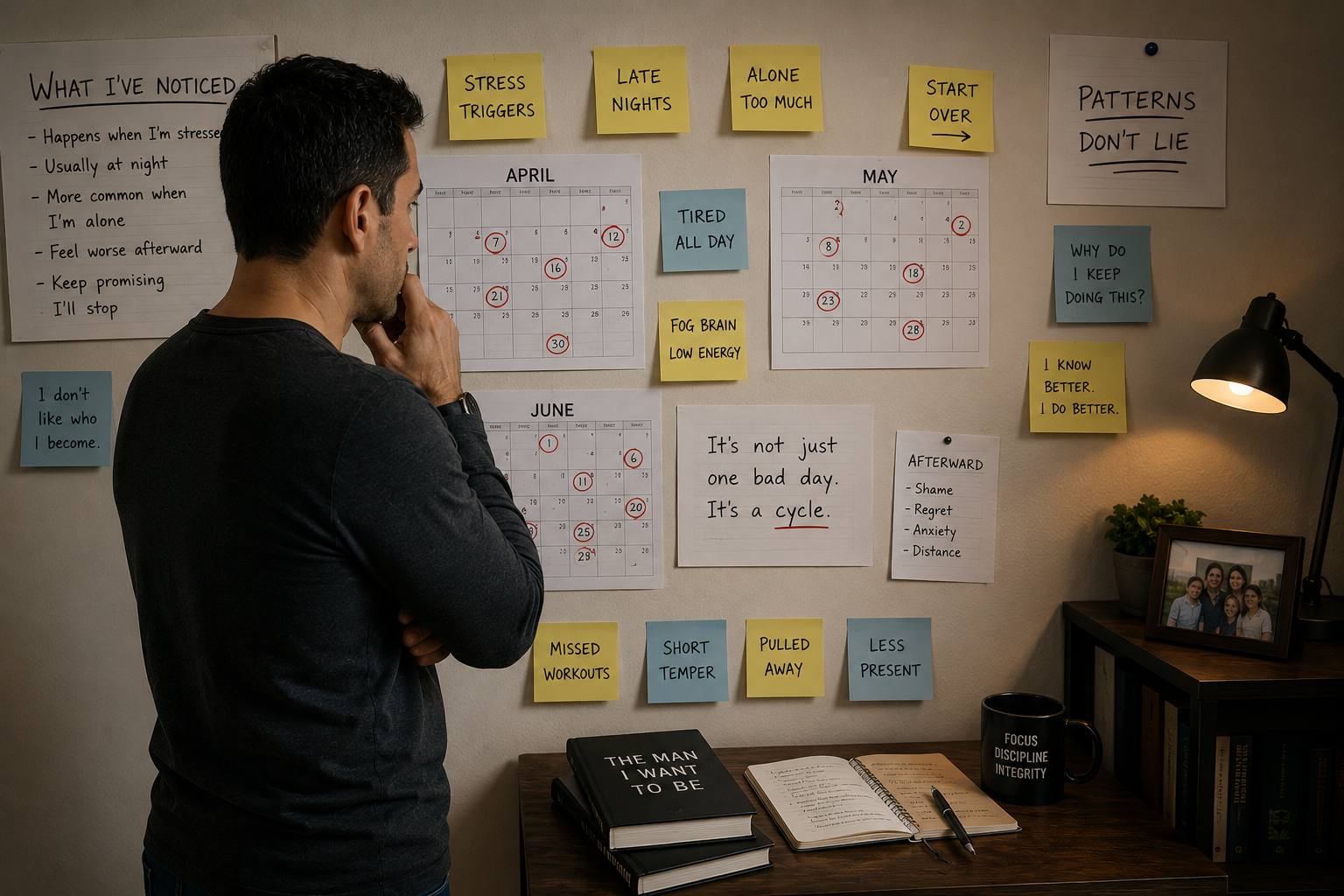
Most people who wonder whether they have a porn addiction aren’t asking because they watched pornography once or twice.
They’re asking because something doesn’t feel right anymore.
Maybe you’ve promised yourself you’ll stop, only to find yourself back in the same cycle days later. Maybe it’s affecting your relationship, your confidence, your work, or the way you see yourself. Or maybe you simply feel like pornography has more control over your life than you’d like to admit.
If that sounds familiar, you’re not alone.
Recognizing the signs of porn addiction isn’t about putting a label on yourself. It’s about honestly evaluating whether pornography has become something that’s controlling you instead of something you’re controlling.
Unlike alcohol or drugs, there isn’t a universally accepted medical diagnosis for porn addiction. Even so, thousands of men experience patterns of compulsive pornography use that leave them feeling stuck, ashamed, and unable to stop despite wanting to.
Instead of asking, “Am I addicted?” a better question is:
“Has pornography become a problem that’s negatively affecting my life?”
Here are some of the most common warning signs.
One of the strongest indicators is losing confidence in your own promises.
You tell yourself:
But days or even hours later, you’re back in the same routine.
Repeated unsuccessful attempts to stop often point toward compulsive behavior rather than simple habit.
What starts as “just a few minutes” regularly turns into an hour or more.
You may find yourself:
Over time, pornography can quietly become one of the biggest consumers of your free time.
Many men notice that the material they once found exciting no longer has the same effect.
As tolerance builds, they begin looking for:
This doesn’t necessarily reflect your true values or desires. It’s often a sign that your brain has adapted to repeated stimulation and is seeking something new.
Secrecy is often one of the earliest warning signs.
Maybe you:
The more energy spent hiding pornography use, the more likely it has become something you’re uncomfortable with.
Pornography doesn’t have to destroy a relationship before it becomes a problem.
You might notice:
Many men first seek help not because of pornography itself, but because of the damage it creates in the relationships they value most.
For many people, pornography isn’t the problem.
It’s the coping strategy.
If you automatically turn to porn whenever you’re experiencing:
it’s worth asking what role pornography has begun playing in your life.
At WSU, we’ve found this to be one of the biggest turning points in recovery. Lasting freedom usually comes from understanding why you’re reaching for pornography in the first place, not simply trying harder to avoid it.
Pornography may be becoming a problem if it consistently interferes with your responsibilities.
Examples include:
When pornography regularly wins over the things that matter most to you, it’s worth paying attention.
Many men describe a predictable cycle:
That cycle can continue for years without understanding what’s driving it.
While guilt alone doesn’t prove addiction, repeated regret followed by repeated behavior often signals that something deeper is going on.
Some men begin noticing that real relationships don’t seem as stimulating as pornography.
You may experience:
These changes can be frightening, but they are often reversible with recovery.
Compulsive pornography use can leave some people feeling mentally drained.
You might notice:
While these symptoms can have many causes, pornography may be worth evaluating if they consistently follow periods of heavy use.
One overlooked warning sign is when pornography starts influencing your daily decisions.
Maybe you:
When your day begins revolving around pornography instead of your priorities, it deserves honest attention.
Perhaps the clearest sign isn’t how often you watch pornography.
It’s how powerless you feel to stop.
Many men don’t watch every day.
Some only binge periodically.
Others can go weeks without pornography before falling back into the same cycle.
Frequency alone doesn’t determine whether it’s a problem.
Loss of control is often the better measure.
Not necessarily.
Many people may recognize one or two of these behaviors without meeting the pattern of compulsive pornography use.
The bigger picture matters.
Ask yourself:
Answering “yes” to several of those questions may indicate it’s time to take the issue more seriously.
One of the biggest misconceptions is that recovery simply means trying harder to quit.
In reality, many men stay stuck because they’re fighting the behavior while ignoring what’s fueling it.
At Wellness Seekers Unlimited, we view pornography as a symptom in many cases, not the root problem. Recovery often involves learning healthier ways to deal with stress, loneliness, shame, anxiety, and other underlying issues while building habits that support lasting change.
That’s why genuine recovery is about far more than counting days without porn.
If you recognize several of these signs of porn addiction, know that you’re not broken, and you’re certainly not alone.
Recovery is possible, especially when you stop fighting the behavior by yourself and begin addressing the deeper patterns behind it. If you’re ready to take that next step, schedule a Confidential Recovery Session. Wellness Seekers Unlimited is here to help.
Yes. Compulsive pornography use is more about loss of control than daily frequency. Some people binge periodically but still feel unable to stop when they want to.
A habit is generally something you can change with relative ease. Compulsive pornography use continues even when it’s creating negative consequences and you’ve made repeated attempts to stop.
Yes. Many people achieve lasting recovery by addressing both the compulsive behavior and the underlying emotional patterns that contribute to it.


© 2026 Sex & Porn Addiction Recovery Program - wellnessseekersultd.com. All Rights Reserved.